
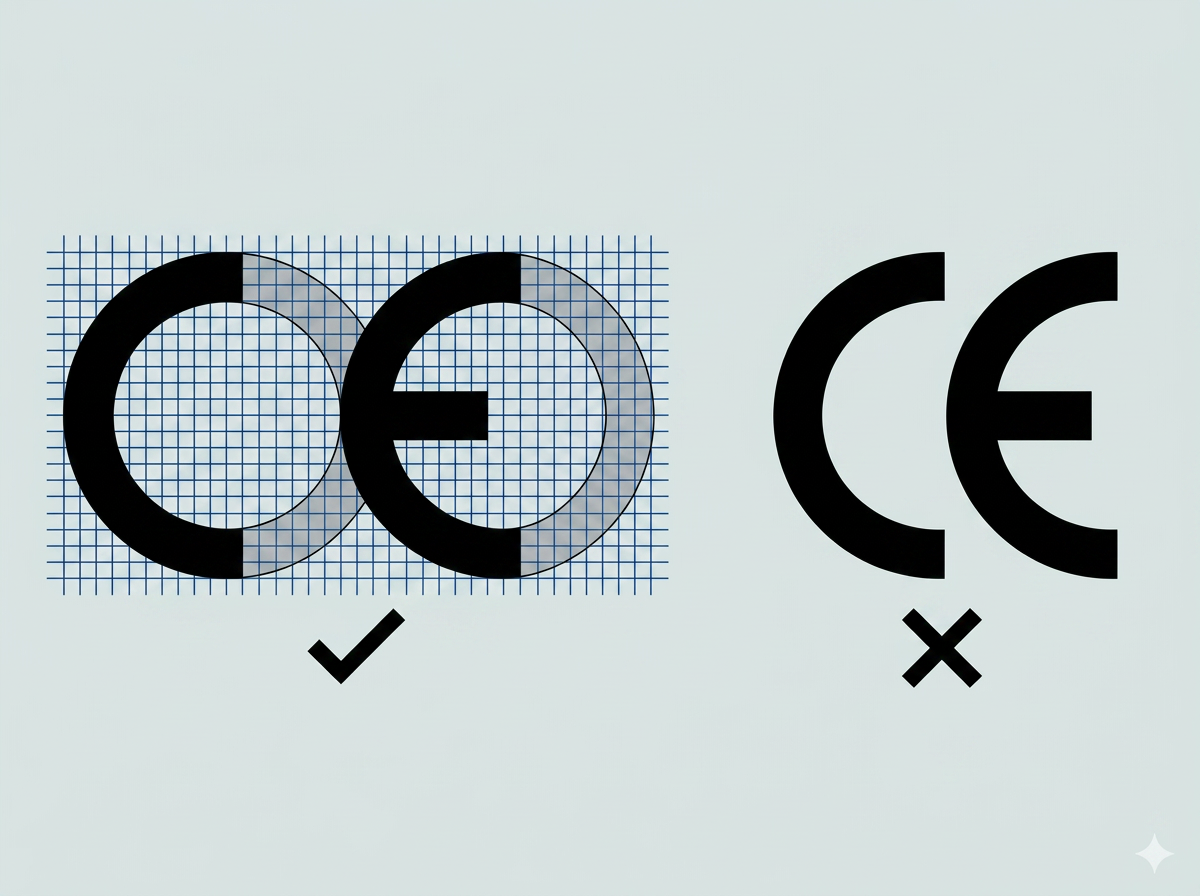
If you've received a product from an Asian supplier with a logo that looks like "CE", you have a legitimate question before importing or listing it for sale: is that the European CE mark, or something else entirely?
The short answer: they are two completely different things. The CE marking is a European legal requirement. The symbol some call "China Export" has no official recognition under any EU legal framework. But the real difference is not just in the logo design — it's in what does or does not exist behind it: technical documentation, conformity assessment, and an identified responsible operator.
Quick answer: CE marking vs China Export
The CE marking is a legal declaration by the manufacturer that a product complies with applicable European legislation. It requires technical documentation, a conformity assessment process, and in many cases the involvement of a notified body. If you want to go deeper into how the full process works, you can explore our CE marking consulting service.
The term "China Export" does not correspond to any official certification recognised by the European Union. It is a popular term used to describe a symbol visually similar to the CE mark that appears on some products manufactured in China, but without any European regulatory backing.
The difference is not just visual — it is legal, documentary, and operational. A logo that looks right does not make a product compliant. What makes a product compliant is the documentation behind it.
What people call "China Export" and why it causes so much confusion
The confusion is understandable: visually, both symbols use the same letters and can be difficult to tell apart at first glance. That is why searches for "China Export logo" or "fake CE mark" are so common among importers and buyers who have received a product and want to know whether the marking is valid for Europe.
This type of symbol appears frequently on electronics imported directly from manufacturers without any evaluation process for the European market, on low-cost items sold through marketplaces, and in situations where the importer assumes that the logo applied at the factory already covers European requirements. That assumption is exactly the kind of mistake that leads to problems at customs, on selling platforms, or in front of a market surveillance authority.
CE marking vs China Export: the differences that actually matter
The most useful comparison is not between two logos, but between two entirely different operational realities.
| CE Marking | "China Export" | |
|---|---|---|
| Legal recognition in the EU | Yes. Required by EU directives and regulations. | None. Does not exist in EU legislation. |
| Who applies it | The manufacturer, after completing a conformity process. | Can appear with no process whatsoever. |
| Documentation required | DoC + technical file + traceability. | No formal requirement attached. |
| Responsibility | The identified manufacturer or importer bears legal responsibility. | No responsible operator is identified. |
| Value at customs | Recognised and verifiable by authorities. | Not valid. May result in goods being held. |
| Value on marketplaces | Amazon, eBay and others may request documentation. | Does not demonstrate conformity. |
Yes. Required by EU directives and regulations.
None. Does not exist in EU legislation.
The manufacturer, after completing a conformity process.
Can appear with no process whatsoever.
DoC + technical file + traceability.
No formal requirement attached.
The identified manufacturer or importer bears legal responsibility.
No responsible operator is identified.
Recognised and verifiable by authorities.
Not valid. May result in goods being held.
Amazon, eBay and others may request documentation.
Does not demonstrate conformity.
A valid CE mark, backed by coherent documentation, allows free circulation of the product throughout the European Economic Area. A symbol with no regulatory backing grants no right to market a product. Furthermore, when the manufacturer is outside the EU, the importer legally assumes responsibility for product compliance — this is set out in Regulation (EU) 2019/1020 on market surveillance.
How to tell them apart visually — and why the logo is never enough
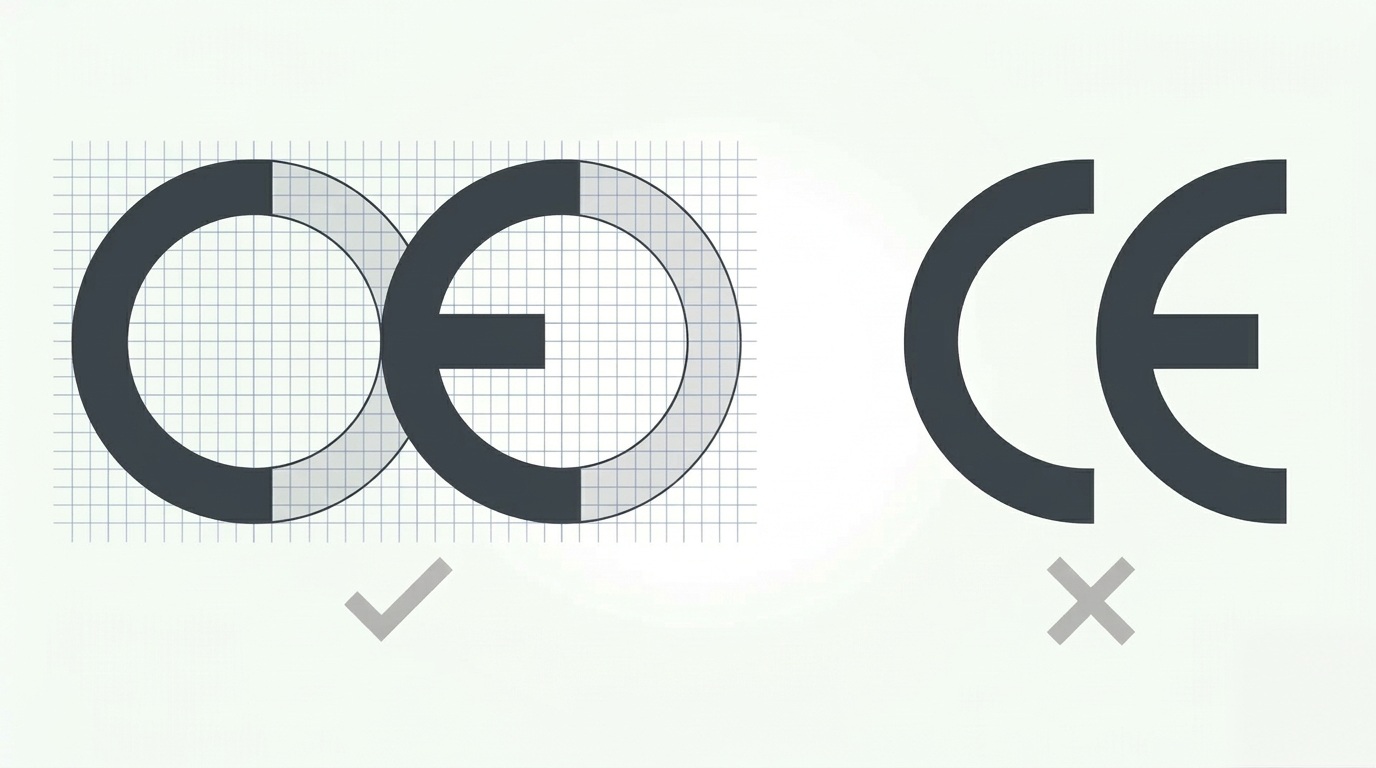
Spacing and proportions of the official CE mark
The official CE mark has a specific regulated design: the letters C and E have defined proportions and a precise spacing between them. In the official CE symbol, both letters sit closer together than in some alternative versions seen on products. The European Commission publishes the official graphic specifications on the CE marking portal.
That said, a visual check is useful as an initial alert, but must never be the sole criterion. A logo with the correct spacing can still belong to a product with no valid documentation behind it.
What to check beyond the logo
- Request the EU Declaration of Conformity from the supplier or manufacturer.
- Verify that the DoC identifies the specific product, references the applicable legislation, and is signed by an identified responsible person.
- Confirm that the manufacturer is correctly identified on the product and in the documents.
- Check that technical documentation exists and is consistent with the product and its intended use.
What documents to request before importing or selling in the EU
EU Declaration of Conformity (DoC)
The DoC is the document through which the manufacturer formally declares that the product complies with applicable EU legislation. To be valid, it must identify the product unambiguously, cite the applicable directives or regulations, include references to the standards used in the assessment, and be signed by an identified responsible person with name and role. A generic DoC with no reference to the specific product, or one without a signature, is an immediate red flag.
Technical documentation and traceability
The technical documentation gathers the evidence supporting that the product meets the applicable essential requirements: product description, standards applied, test results or risk analysis. It is not routinely submitted to any authority, but it must be available upon inspection. In addition, the manufacturer must be identified on the product, and if they are outside the EU, an EU authorised representative must be in place — a requirement reinforced by the General Product Safety Regulation (GPSR) in force since December 2024.
Red flags that should raise concern
- The supplier cannot provide the DoC or takes weeks to respond.
- The declaration references directives that do not match the product type.
- There is no reference to technical standards or notified bodies when the product would require them.
- The manufacturer is not identified on the product or in any document.
Did your supplier send a product with a CE logo but without coherent technical documentation? It is worth reviewing conformity before importing or continuing to sell. At Conformity Point we can help you identify the issue and find the right path forward.
Conformity Point
Importing electrical or electronic products?
The CE logo is only one part of the review. Check whether your supplier's RoHS evidence actually covers the model, materials and configuration you intend to sell.
Read the RoHS guide for importersWhat risks do you take when selling a product with a questionable mark?
- At customs: goods held, returned, or destroyed.
- On marketplaces: Amazon, eBay or Bol may remove the listing or suspend the account if valid documentation cannot be provided on request.
- In market surveillance: authorities may order the product withdrawn from the market and publish the incident in the European Safety Gate / RAPEX system, with the applicable economic penalties.
- Contractually and reputationally: customer claims, returns, and brand damage.
Step-by-step: what to do if you suspect the marking is not valid
Step 1. Pause the import or sale if the risk is real.
Placing a non-compliant product on the market is far more costly to correct than catching the problem early.
Step 2. Request and review the documentation.
Ask for the DoC and the technical documentation. Check that they are consistent with the product and signed by an identified responsible person.
Step 3. Confirm whether the product actually requires CE marking.
Not all products do. The applicable legislation depends on the product type, its design, and its intended use.
Step 4. Check consistency between the product, labelling, and documents.
The model number in the DoC must match the one on the product. If it does not, there is a problem.
Step 5. Decide on the action: correct, test, relabel, or don't sell.
Options include completing missing documentation, submitting the product for testing, correcting the labelling, or simply not placing it on the market until everything is in order.
Common mistakes when reviewing products with a supposed CE mark
Assuming the logo is enough.
The most common mistake. A logo without documentation has no legal value. Conformity is not visual — it is documentary.
Accepting a generic or incomplete DoC.
A declaration that does not identify the specific product, references incorrect directives, or is unsigned has no legal value, regardless of how official it looks.
Not checking who acts as importer or responsible person in the EU.
If the manufacturer is outside the EU and no responsible operator is identified, the product cannot be legally placed on the market. With the GPSR now in force, this point is more critical than ever.
Frequently asked questions about CE marking and China Export
What to keep in mind before importing or selling in the EU
The difference between the CE marking and the symbol many call "China Export" is not about logos — it is about documentation, responsibility, and real conformity. A product carrying a CE logo but without a valid DoC, without technical documentation, and without an identified responsible operator does not comply with European legislation, regardless of what the printed symbol looks like.
If you have doubts about whether your documentation is sufficient, the time to check is before placing the product on the market — not after someone questions it.
At Conformity Point we can help you verify whether a product can carry CE marking, review documentation before importing, or confirm whether your technical file supports commercialisation in the EU.
Get in touchNote: This article contains general information about European regulatory requirements. The specific assessment of a product depends on its type, intended use, design, and available documentation. It does not replace a specific conformity review.

Author
Written by Juan Manuel Beltrán, Founder & Product Compliance Consultant at Conformity Point. Specialist in consumer product compliance for the European market, he helps manufacturers, importers and brands sell consumer products in Europe.
Last updated: 7 April 2026.