
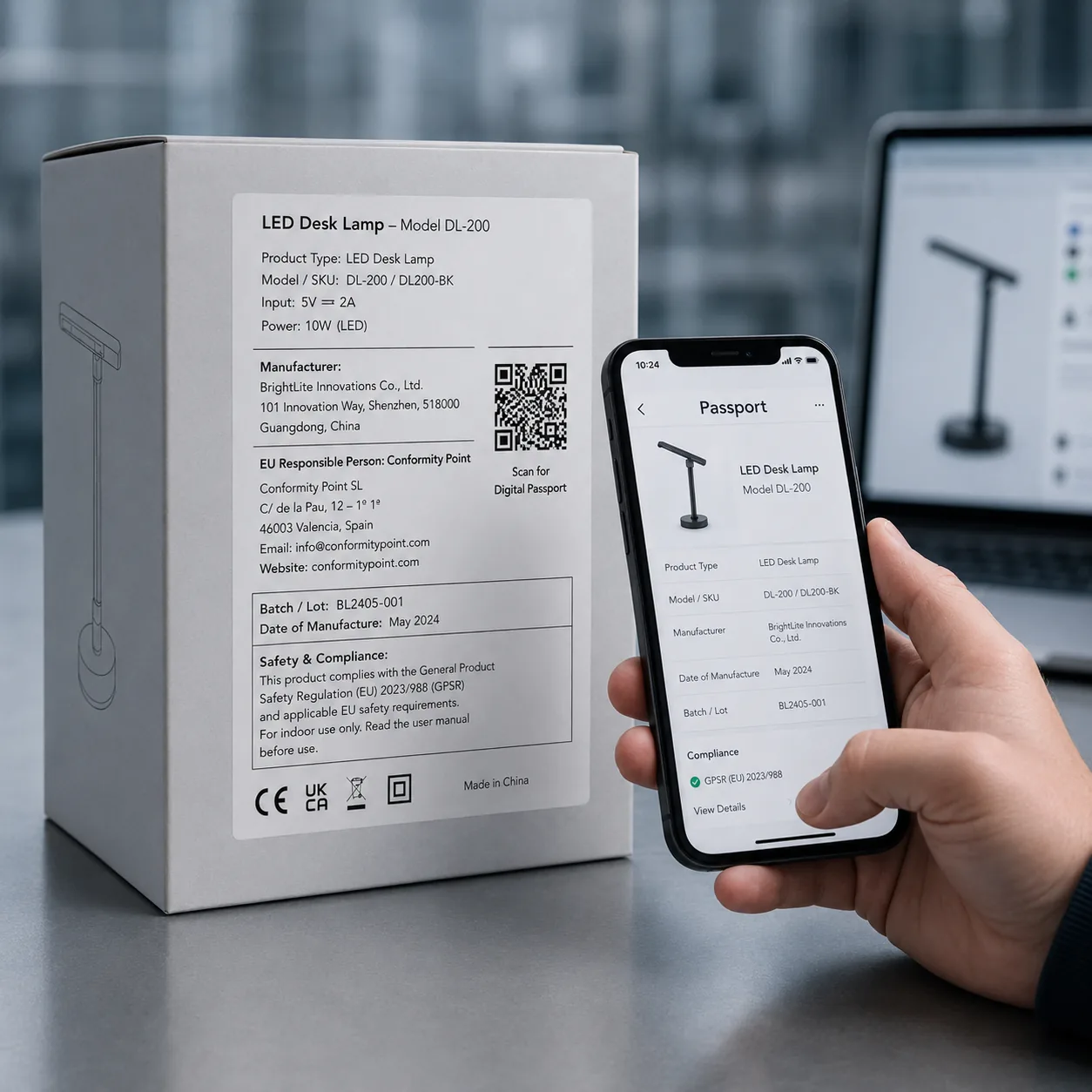
The Digital Product Passport is part of the EU's move toward product sustainability, traceability and circular economy. Not all consumer products need one today, and understanding the legal situation of your category is what makes the difference before investing in tools or platforms.
If you manufacture, import or distribute textiles, furniture, mattresses, tyres, batteries or energy-related products — or sell them on marketplaces like Amazon, eBay or Bol — what matters right now is not choosing a QR-code platform, but knowing what legal situation your product category is actually in.
Digital Product Passport for Consumer Products: The Short Answer
The Digital Product Passport is part of the EU's move toward product sustainability, traceability and circular economy. Not all consumer products need one today. Under the ESPR, the exact digital product passport obligations for most consumer products will depend on product-specific delegated acts, which have not yet been adopted for most sectors.
The consumer product groups currently flagged as priorities include textiles and apparel, furniture, tyres, mattresses and certain energy-related products. Batteries must be treated separately, because the battery passport comes from the Batteries Regulation, not from the ESPR framework.
What Is a Digital Product Passport?
A Digital Product Passport is a structured set of digital information about a product, component or material, intended to let actors such as authorities, consumers, repairers, recyclers and other supply chain agents access relevant data about that product.
It is not a PDF, a static webpage or a marketing label. Think of it more like the product's identity card: structured, machine-readable and with different access levels depending on who is checking it.
The QR code, NFC tag or other similar mechanism is not the passport itself. It is just the access point. The actual content, the access rights and the required level (model, batch or unit) will depend on the specific delegated act applicable to that product category.
How the ESPR Changes Product Compliance
Regulation (EU) 2024/1781, the Ecodesign for Sustainable Products Regulation (ESPR), establishes the general framework for setting ecodesign and information requirements, including Digital Product Passport requirements. But the ESPR is a framework regulation: it does not by itself impose an active digital product passport obligation on all consumer products today.
A product will only be required to have a digital passport once a specific delegated act exists for that category establishing it. That delegated act is what defines which data is required, what type of access carrier is used, at what level it applies (model, batch or unit), who has the right to consult each piece of data, and who is responsible for creating or updating the passport.
In practice, this means that being mentioned in a European Commission working plan is not the same as already having a binding legal obligation. Implementing Regulation (EU) 2026/1778, published on 17 July 2026, lays down the arrangements for the EU Digital Product Passport registry. It develops the common infrastructure, but does not by itself require every consumer product to have a passport already: scope and timing still depend on the legislation applicable to each category.
Which Consumer Products Are Most Likely to Be Affected First
The European Commission's ESPR 2025-2030 Working Plan identifies several product groups as priorities for future ecodesign and information requirements, which may include the digital product passport. For consumer products, the most relevant groups currently are:
- Textiles and apparel
- Furniture
- Tyres
- Mattresses
- Certain energy-related products
Steel and aluminium also appear in the working plan, but as intermediate products, not as the focus of this guide, which is aimed at final consumer products.
It's important to understand that appearing in the working plan means the Commission is working on possible future requirements for that category, not that the digital product passport is already mandatory. The concrete obligation, with its dates and content, only arises once the corresponding delegated act is adopted.
Batteries: a separate, more concrete case
The battery passport is an obligation separate from the general ESPR framework. It comes from Regulation (EU) 2023/1542 on batteries. From 18 February 2027, every LMT battery, every industrial battery with a capacity greater than 2 kWh and every electric vehicle battery placed on the market or put into service must have a battery passport.
From that same date, all batteries must carry a QR-code marking, but for batteries that do not fall into the categories above, that QR code provides access to other applicable information, not necessarily to a full battery passport.
If your product includes batteries, it's worth reviewing this in detail: learn about the requirements of the EU Battery Regulation.
Toys: another case confirmed by its own regulation
Toys also already have a confirmed legal basis, separate from both the ESPR and the Battery Regulation. The new Toy Safety Regulation, Regulation (EU) 2025/2509, was published in the Official Journal of the EU in December 2025 and entered into force on 1 January 2026. It establishes that every toy placed on the EU market must have a digital product passport demonstrating its conformity with the regulation, accessible through a data carrier such as a QR code.
Unlike textiles or furniture, this is not a forecast from the ESPR working plan, but an already adopted and published regulation. What is not yet settled is the exact technical detail of the passport's content, which is still under development. Full application of the regulation, including the digital product passport, is set for 1 August 2030.
When Will the Digital Product Passport Apply?
The ESPR Working Plan 2025-2030 provides indicative dates for adopting measures for each product group. These are planned adoption dates, not dates by which every manufacturer must already have an operational passport:
- Textiles and apparel: indicative adoption in 2027.
- Tyres: indicative adoption in 2027.
- Furniture: indicative adoption in 2028.
- Mattresses: indicative adoption in 2029.
- Energy-related products: the plan continues sector-specific work and includes horizontal measures for electrical and electronic equipment; check the measure for the specific product.
The delegated act for each category will determine whether a passport is required, its content and its application date. As a general rule, the ESPR provides at least 18 months between a delegated act entering into force and its application, except in duly justified cases. Do not turn an indicative adoption schedule into a confirmed compliance deadline.
Batteries and toys are different: there, the date is already fixed by law, not by forecast. The battery passport applies from 18 February 2027, under the Battery Regulation, for the categories mentioned above. The digital passport for toys applies from 1 August 2030, under the Toy Safety Regulation.
When It Does Not Apply Yet
It's just as important to be clear about the limits:
- A product does not need a Digital Product Passport merely because it is sold online.
- A product does not need a Digital Product Passport merely because it is a consumer product.
- A product does not need a Digital Product Passport merely because it carries CE marking.
- A small battery for household use does not need a full battery passport merely because it is a battery, unless it falls into one of the specific categories covered by the Battery Regulation.
- A toy does not need its digital passport to be operational today: the Toy Safety Regulation sets full application for 1 August 2030, although it's worth starting to prepare beforehand.
This doesn't mean you shouldn't prepare. It means preparation should be based on your product's actual category, not on generic headlines.
If your consumer product is subject to other obligations such as the General Product Safety Regulation (GPSR) and the responsible person requirement, that is a different, already-active obligation, which you should not confuse with the Digital Product Passport.
What Information May Be Required in a Digital Product Passport?
The exact content will depend on the delegated act applicable to each product category. In general terms, this type of passport tends to be structured around three blocks of information:
Product Identification
Model, batch or unit identifier, manufacturer, importer, responsible economic operator and other unique identifiers where required.
Technical and Sustainability Data
Materials used, substances of concern, durability, repairability, availability of spare parts, recycled content and environmental information, where applicable to the relevant category.
End-of-Life Data
Information on dismantling, recycling, reuse, collection and waste management, depending on the type of product.
Access to each of these blocks may vary: a market surveillance authority, a consumer or a recycler do not necessarily have the same access rights to all the information in the passport.
How Manufacturers and Importers Should Prepare
- 1Classify your product category. Check whether it is already covered by a specific sector-specific rule (such as batteries), prioritised under the ESPR working plan, or only potentially affected in the future.
- 2Review current sector-specific rules and ESPR priorities. Not all categories move at the same pace.
- 3Map the data you already have. Quality, purchasing, engineering, suppliers, logistics and technical documentation often already contain a good part of the relevant information.
- 4Request missing data from your suppliers. Especially if you depend on manufacturers outside the EU.
- 5Define who is responsible for creating and updating each piece of data. The passport is not a static document; it needs governance.
- 6Check whether your technical documentation, labelling and sustainability claims are already consistent with each other. Inconsistencies today will become problems tomorrow.
- 7Assess technology only at the end, once you understand the real legal scope and the data you're likely to need.
Technology — QR codes, NFC, ERP or PLM integration, databases, cloud platforms or blockchain — can help implement the passport, but it does not replace the regulatory assessment. Blockchain can be useful for ensuring integrity and traceability, but the ESPR framework does not generally require it.
If you sell textiles, furniture, mattresses, tyres, batteries, energy-related products or other consumer goods in the EU, the first step is not choosing a QR-code platform. It is confirming whether your product category is already covered, prioritised under the ESPR, or only potentially affected by future measures. Conformity Point can help with an EU product compliance assessment tailored to your case.
Separate note: The ESPR also includes rules on destroying unsold consumer products, separate from the Digital Product Passport. The ban on destroying unsold apparel, accessories and footwear applies to large enterprises from 19 July 2026 and medium-sized enterprises from 19 July 2030. Micro and small enterprises are exempt from this ban.
Common Mistakes Companies Should Avoid
1.Thinking the digital passport is just a QR code. The QR code is the access point, not the content.
2.Assuming all products have the same deadline. Each category depends on its own delegated act.
3.Confusing the Digital Product Passport with CE marking or the GPSR responsible person requirement. These are distinct obligations, with distinct legal bases. If you have questions about CE marking, check out which products need CE marking.
4.Waiting too long to request data from suppliers. The later you start, the harder it will be to get reliable information in time.
5.Using sustainability claims you cannot support with verifiable data.
6.Buying a software platform before knowing what dataset you actually need.
7.Treating the ESPR working plan as if it were already a direct legal obligation for every product mentioned in it.
FAQ: Digital Product Passport for Consumer Products
What to Remember Before Selling in Europe
The Digital Product Passport is a real piece of the European regulatory framework, but it is still not a uniform obligation for all consumer products. What matters is your product's exact category: whether it is already covered by its own sector-specific rule such as the Battery Regulation or the Toy Safety Regulation, whether it is prioritised in the ESPR working plan, or whether it could only be affected in the future.
Preparing now doesn't mean buying software. It means correctly classifying your product, mapping the data you already have and identifying gaps before the obligation becomes urgent.
If you want to confirm how this affects you, you can contact Conformity Point or visit our website to learn about all our product compliance services.
Official sources

About the author
Written by Juan Manuel Beltrán, Founder & Product Compliance Consultant at Conformity Point. A specialist in consumer product compliance for the European market, he helps manufacturers, importers and brands sell consumer products in Europe.
Last updated: 12 October 2026.
This article provides general regulatory information. Whether your specific product requires a Digital Product Passport depends on its category, the applicable EU legislation, the relevant delegated acts, the intended use, the data available in your supply chain and the documentation you hold.