
EPREL registration is mandatory before placing any product model covered by EU energy labelling legislation on the EU market. Without prior registration, the product cannot be lawfully placed on the European market. If the manufacturer is not established in the EU, the importer or authorised representative takes on responsibility as the supplier. This article explains when EU energy label requirements apply, who is responsible, what information the label contains and what documentation you need before you start.
EPREL registration key dates
- Oct 2024Supplier verification mandatory to register or edit models in EPREL
- Apr 2025NTR identity required for electronic seals of legal persons in verification
- Jun 2025Smartphones and slate tablets covered, with specific exclusions
- 2026Regulation (EU) 2017/1369 + product-group-specific delegated acts in force
Quick answer: what is EPREL registration and when is it mandatory?
EPREL registration is mandatory when the product belongs to a group covered by EU energy labelling legislation and a specific delegated act exists for that category. In those cases, the supplier must complete registration before placing the model on the EU market — not after the first sale.
What varies is which products are covered and who is responsible for registration. Not every electrical product is automatically included, and the manufacturer is not always the party who must register.
What EPREL is and what it is used for
EPREL (European Product Registry for Energy Labelling) is the European registry where suppliers register product models before placing them on the EU market. It contains the product's technical data, the official energy label and the product information sheet, and serves as a reference for market surveillance authorities and for consumers who scan the QR code on the label.
Public access is available to consult model information, but registration and data management are the supplier's responsibility.
Two relevant dates for the operational management of registration:
- Since 22 October 2024, supplier verification in EPREL is mandatory to register new models or edit existing ones.
- Since 22 April 2025, the NTR identity type is required for electronic seals of legal persons in that verification process.
More information at the official EPREL page for suppliers.
When do EU energy label requirements apply?
EU energy label requirements apply when the product falls within the scope of Regulation (EU) 2017/1369 and a specific delegated act exists for that product group. Not every electrical product is automatically included.
Some energy-related products may be subject to ecodesign requirements but not necessarily to energy labelling. Before registering a model in EPREL, the first step should always be to confirm whether the product actually falls within the energy labelling scope.
Products covered as of 2026
The following are the main product groups with EU energy labelling obligations. The final assessment does not depend solely on the commercial name of the product, but on its technical category, intended use, design and applicable delegated act:
- Household refrigerators, freezers and refrigerating appliances
- Household washing machines and washer-dryers
- Household dishwashers
- Household tumble dryers
- Domestic ovens and range hoods
- Electronic displays (televisions and monitors)
- Light sources (lamps and certain lighting products)
- Commercial refrigeration appliances, including equipment with a direct sales function
- Professional refrigerated storage cabinets
- Air conditioners and certain climate control equipment
- Water heaters and space heaters
- Solid fuel boilers
- Ventilation units
- Smartphones and slate tablets, from June 2025, with specific exclusions depending on design and technical characteristics
- Tyres, with their own specific labelling system
If your product does not appear on this list or you have doubts about its classification, the key step is to verify whether an active delegated act exists for that category — not to assume the obligation applies or does not apply.
Under the EU energy labelling framework, the party responsible for EPREL registration is the supplier, which can be:
- The manufacturer established in the EU.
- The authorised representative designated by a non-EU manufacturer.
- The importer, when placing the product on the EU market without an authorised representative.
Many non-EU companies assume their European distributor will handle registration. In practice, if there is no authorised representative, the importer is the responsible supplier and must manage EPREL registration directly.
Distributors do not register models in EPREL. Their obligation is to display the energy label and product information correctly when selling covered products, but that information must come from the supplier.
If you need to designate an EU authorised representative, this is the point in the process where that should be resolved before starting the registration process.
What information appears on the EU energy label?
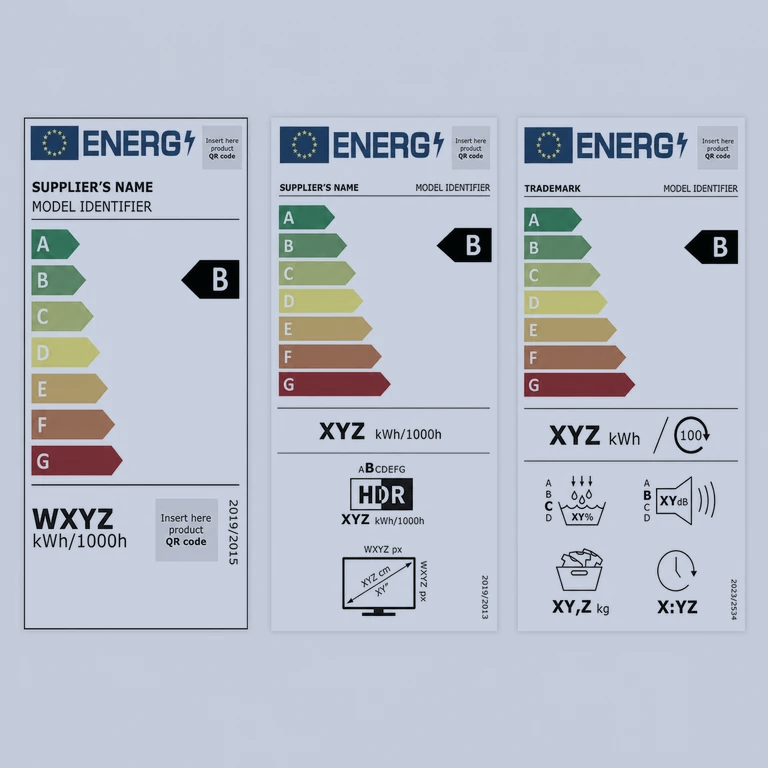
The energy label is not a design element: it is the result of technical data declared by the supplier and linked to a specific model record in EPREL. Each product group measures different parameters — a washing machine does not display the same information as a refrigerator or a smartphone — but most labels share these elements:
- QR code: links to the public model record in EPREL and confirms that the label is associated with a registered model.
- Brand and model identifier: must match exactly those used in EPREL, the technical documentation and the online listing.
- Energy scale: normally from A to G for product groups already rescaled.
- Model energy class: the specific rating of the product within the applicable scale.
- Energy consumption: expressed differently depending on the product (per cycle, annual consumption, lighting parameters, etc.).
- Specific pictograms: summarise relevant data for that product type: capacity, water consumption, noise level, repairability and other performance characteristics.
- Regulatory reference: identifies the applicable framework for that label.
If the product changes, the model identifier does not match or the data is not backed by technical documentation, the label is no longer valid for that product. Manually generated labels, labels using outdated scales (such as A+, A++ or A+++) for product groups already rescaled to A-G, and labels without a QR code linked to a valid EPREL record must not be used.
From technical data to EPREL registration: the step-by-step process
Before registering a product in EPREL, the supplier must have reliable technical data available. The typical process follows this sequence:
- 1Confirm whether the product falls within the scope of energy labelling legislation and the applicable delegated act.
- 2Determine which parameters must be measured or calculated for that product group.
- 3Carry out the necessary tests, measurements or calculations, normally with the support of a competent laboratory when the company does not have sufficient technical means.
- 4Obtain the test report or equivalent technical evidence to support the declared values.
- 5Prepare the technical documentation, the product information sheet and the required model data.
- 6Create and verify the supplier organisation in EPREL and set up the brand or trademark.
- 7Register the model in EPREL with the model identifier, technical parameters and required documentation, before placing it on the market.
- 8Generate the official EU energy label, product information sheet and QR code from EPREL or via the accepted formats.
- 9Provide the label and product information sheet to distributors, ecommerce teams and marketplaces so they can display the information correctly.
The test report is not the same as the public product information sheet: it forms part of the technical evidence supporting the declared data and may be requested as compliance documentation. The most common failure is not simply "not having the label", but not having a coherent documentary chain from testing to the online listing.
Unsure whether your product category falls within scope or what documentation you need?
Conformity Point can review the product before you start the EPREL registration process.
Online sales and marketplaces: EU energy label obligations
When a covered product is sold online, the platform or marketplace must display the energy label and product information correctly and visibly. On marketplaces such as Amazon, the seller must upload the required energy labelling information: the energy label, the product information sheet and attributes such as the energy class.
All of that information is provided by the supplier. Without it, the listing may be blocked or fail to meet the display requirements set out in the regulation.
Common EPREL registration mistakes
1.Assuming registration can be done after the first sale. For covered models, registration must be completed before placing the product on the market.
2.Using the manufacturer's name when the importer is the responsible supplier. If there is no authorised representative, the importer must register as the supplier — not act as though the manufacturer is responsible.
3.Creating an EPREL account without completing supplier verification. Since October 2024, models cannot be registered or edited without verification.
4.Inconsistent model identifiers. The model identifier in EPREL, in the technical documentation and in the online listing must be identical. Any discrepancy can create issues with market surveillance.
5.Not submitting the product information sheet. It is not an optional document: it forms part of the supplier's documentary obligations.
6.Using outdated scale references (A+, A++, A+++). For product groups already adapted to the A-G scale, using the old scale makes the label non-compliant.
7.Publishing ecommerce listings without the required energy label information. Online sellers are obliged to display this information. Without correct data from the supplier, they cannot comply.
8.Assuming a distributor can fix missing supplier registration. They cannot. The distributor depends on the supplier having completed registration and providing the correct label and product information sheet.
What happens if a product is not correctly registered?
- The marketplace or distributor may refuse to list the product.
- The label QR code does not lead to a valid public EPREL record.
- Market surveillance authorities may request technical documentation.
- The product information displayed to consumers may be incomplete or incorrect.
- Product launch timelines may be significantly delayed.
Frequently asked questions about EPREL registration and the EU energy label
What to keep in mind before selling in Europe
EPREL registration is not an administrative step that follows the first sale: it is a prerequisite for placing covered products on the market. The EU energy label is part of a compliance system — not just a graphic — and the responsibility for managing it lies with the supplier, whether that is the manufacturer, the authorised representative or the importer.
Knowing whether your product is within scope, who must act as supplier and what documentation supports the declared data is what determines whether the process moves forward smoothly or is blocked at customs, on the platform or by a market surveillance authority.
Selling appliances or energy-labelled products in the EU?
EPREL registration must be completed before placing products on the market. Supplier verification requirements are already in force.
At Conformity Point we can help you:
- Confirm whether EPREL registration applies to your product category
- Identify who must act as the responsible supplier in EPREL
- Review the documentary chain: testing, technical data, product information sheet and label
- Verify model identifier consistency across EPREL, documentation and listing
- Complete supplier verification in EPREL
- Prepare the information for distributors and online platforms
If you need broader EU market access support, see our CE marking consulting and EU Responsible Person service.
Official sources and references

About the author
Written by Juan Manuel Beltrán, Founder & Product Compliance Consultant at Conformity Point. Specialist in consumer product compliance for the European market, he helps manufacturers, importers and brands sell consumer products in Europe.
Reviewed for regulatory accuracy as of June 2026.
Last updated: June 2026.
This article provides general information about EPREL registration and EU energy labelling legislation. The specific application of requirements depends on the product, the product group and the role of the economic operator. For a product-specific assessment, consult a compliance specialist.