
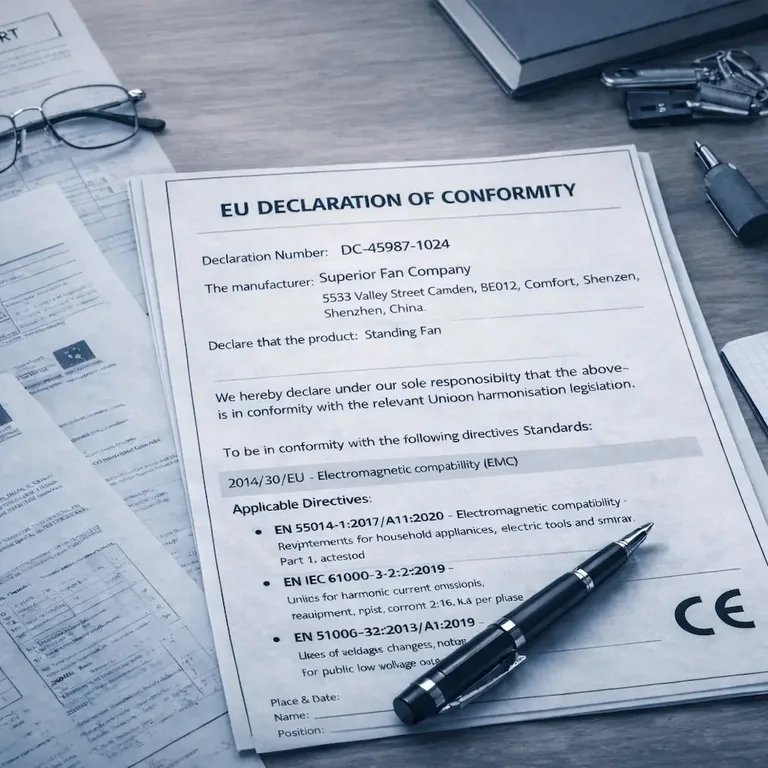
The EU Declaration of Conformity (DoC) is the legal document through which the manufacturer — or their authorised representative in the EU where applicable — declares under their sole responsibility that a product complies with the applicable EU harmonisation legislation. It is a central element of the CE marking process and, in practice, one of the documents that causes the most problems when it is poorly drafted, incomplete or signed by the wrong person.
If you are preparing the technical documentation for a product intended for the European market, this article explains what a valid declaration must contain, how to interpret the structure established by the EU and what mistakes to avoid before the product reaches customs, a marketplace or a market surveillance inspection.
What legal function does this document serve
The EU Declaration of Conformity is not a certificate issued by a third party, nor is it standalone proof that a product is safe. It is a formal declaration by the manufacturer — or their authorised representative — that carries direct legal consequences: whoever signs it assumes responsibility for ensuring that the product meets the essential requirements set out in the applicable legislation.
- It is mandatory in order to affix the CE marking to products that require it.
- It must be available to market surveillance authorities upon request.
- It may be required by customs, marketplaces or customers as a condition for sale or import.
The DoC does not replace the conformity assessment or the technical file. It is the formal outcome of that process: the document that records that the assessment has been carried out and that the product complies with what is declared. Without the technical file to back it up, the declaration has no value in an inspection.
When you need an EU Declaration of Conformity — and when you don't
The EU Declaration of Conformity applies when a product is subject to EU harmonisation legislation that explicitly requires it. This is generally the case when the product must carry the CE marking.
Some examples of categories that require it: toys, electrical equipment, machinery, personal protective equipment, medical devices, radio equipment, construction products, among others. In all these cases, the applicable directive or regulation expressly establishes the obligation to issue an EU Declaration of Conformity before placing the product on the market.
It does not apply in all cases. Some products are regulated under other normative frameworks — such as the General Product Safety Regulation (GPSR) — which require technical documentation and a safety assessment, but do not necessarily require an EU Declaration of Conformity in the same format as harmonisation legislation. In addition, some food, cosmetic or chemical products have their own documentation requirements that do not follow the same structure.
If you are unsure whether your product needs an EU Declaration of Conformity or whether it is subject to harmonisation legislation, that is precisely the first step to determine: identifying the applicable regulation and the documentation requirements that derive from it.
What the EU Declaration of Conformity must include
The minimum mandatory structure of an EU Declaration of Conformity is defined in the applicable harmonisation legislation. Decision 768/2008/EC of the European Parliament and of the Council, which establishes the common framework for the marketing of products in the EU, sets out the elements that this document must contain in its Annex III. Subsequent sectoral directives and regulations reproduce or adapt this structure.
The following are the elements that every valid EU Declaration of Conformity must include:
1. Identification of the manufacturer or authorised representative
Name, registered trade name or trademark and contact address of the manufacturer. If the manufacturer is based outside the European Economic Area and has appointed an authorised representative in the EU, the authorised representative must also be identified.
2. Product identification
The product must be identifiable in an unambiguous and traceable manner. This includes, depending on the case: product name, model, reference number, batch, series or any other element that allows exact identification. A generic description without a specific reference is one of the most common mistakes.
3. Declaration of responsibility
An explicit statement that the manufacturer assumes sole responsibility for the conformity of the product with the applicable harmonisation legislation.
4. Legislative basis and technical standards
The EU harmonisation legislation with which the product is declared compliant must be indicated: the applicable directive(s) or regulation(s), with their full references. The harmonised standards or other technical specifications used as the basis for the conformity assessment must also be indicated where applicable. This point is critical: incomplete, incorrect or outdated legislative references are a frequent source of problems.
5. Notified body details (where applicable)
If the conformity assessment procedure required the involvement of a notified body — as is the case for certain assessment modules in specific sectors — the name of the body, its identification number and the number of the certificate issued must be stated.
6. Signature, place, date and name of signatory
The declaration must be signed by a competent person with the authority to bind the manufacturer. The place of issue, the date and the full name and position of the signatory must be stated. Signing with a generic name, without a stated position, or with the signature of someone without sufficient authority is another common mistake.
The official EU template: structure and how to use it correctly
The EU does not publish a single closed universal template valid for every product. What exists is a model structure defined in the harmonisation legislation — particularly in Decision 768/2008/EC and in sectoral directives — which sets out the minimum elements the document must contain.
Many manufacturers make the mistake of downloading a generic template from the internet, filling in the fields and considering it valid. That is not sufficient. The validity of the declaration depends on three factors that no template can guarantee on its own:
- 1That the legislation indicated is genuinely the legislation applicable to the product, taking into account its category, intended use, technical characteristics and target market.
- 2That the technical standards referenced are the ones currently in force at the time of commercialisation and that they were actually applied in the conformity assessment.
- 3That the technical file supports what is declared. A formally impeccable declaration without sufficient technical documentation has no practical or legal value in an inspection.
If your sectoral legislation has its own declaration format — as is the case with some medical device or radio equipment regulations — you must follow the format established in that specific regulation, not the generic model.
💡 If you already have an EU Declaration of Conformity but are unsure whether the content, signature or regulatory references are correct, an early document review can prevent problems further down the line. Check out Conformity Point's CE marking consulting service.
How the DoC relates to the technical file
The EU Declaration of Conformity and the technical file are two distinct documents with distinct functions, but they are absolutely interdependent.
The declaration is the public document that the manufacturer issues and that can accompany the product or be made available to interested parties. The technical file is the internal documentation — not always public — that demonstrates how and why the product meets the applicable essential requirements: technical drawings, risk assessments, test results, description of the manufacturing process, instructions for use, etc.
What the DoC declares must be justified in the technical file. If the declaration references a harmonised standard, the technical file must contain evidence that this standard was correctly applied. If the product went through an assessment with a notified body, the certificate issued must be in the technical file.
A common mistake is preparing the declaration before the technical file is consolidated, or updating the declaration without updating the supporting documentation. Both documents must progress in parallel and remain aligned.
The technical file must be kept for at least 10 years from the date the product was last placed on the EU market, unless sectoral legislation establishes a different period. The EU Declaration of Conformity must be available for the same period.
Common mistakes that weaken or invalidate the declaration
Incorrect or incomplete legislative references.
Stating only the name of the directive without the official number, citing a directive that has been repealed and replaced, or omitting one of the applicable directives when the product falls under several regulations.
Poorly identified product.
Declarations that identify the product too generically ("plastic toy") without a model reference, batch or serial number that allows real traceability.
Outdated technical standards.
Referencing harmonised standards that have been withdrawn or replaced. Standards are updated frequently; a standard that was valid three years ago may no longer be valid today if it has been replaced by a new version.
Incorrect signature or insufficient authority.
The declaration must be signed by someone with the legal power to bind the manufacturer. Any employee or a generic title without representation is not sufficient.
Failure to update following changes.
If the product undergoes significant modifications, if the applicable legislation changes or if the normative basis is updated, the declaration must be updated. Maintaining an old declaration for a product that has evolved is a real regulatory risk.
Declaration issued without sufficient technical file.
This is probably the most serious mistake: signing a declaration of conformity without having carried out the conformity assessment properly or without having the technical file to support it.
Frequently asked questions about the EU Declaration of Conformity
What you need to remember before selling in Europe
The EU Declaration of Conformity is not a minor administrative formality. It is a legal document that commits the manufacturer or their representative, that can be requested at any time by authorities, customs or marketplaces, and whose validity depends directly on the technical file that supports it being in order.
The most common problems do not come from the absence of the document, but from declarations that are formally correct but lack sufficient technical backing, contain outdated references or have been signed without adequate authority.
If you need to validate or redo your EU Declaration of Conformity — or check whether your technical file genuinely supports it — Conformity Point can review your documentation before the product reaches customs, a marketplace or a market surveillance inspection.
Need help with your EU Declaration of Conformity?
At Conformity Point we help manufacturers, importers and brands prepare, review and correct their EU Declarations of Conformity — so the document is legally sound before it reaches customs, a marketplace or a market surveillance inspection.
Learn more about Conformity PointThis article provides general information about the European regulatory framework. Each product may be subject to specific requirements. Always consult a specialist to assess your specific case.

Author
Written by Juan Manuel Beltrán, Founder & Product Compliance Consultant at Conformity Point. Specialist in consumer product compliance for the European market, he helps manufacturers, importers and brands sell consumer products in Europe.
Reviewed and updated: March 2025