
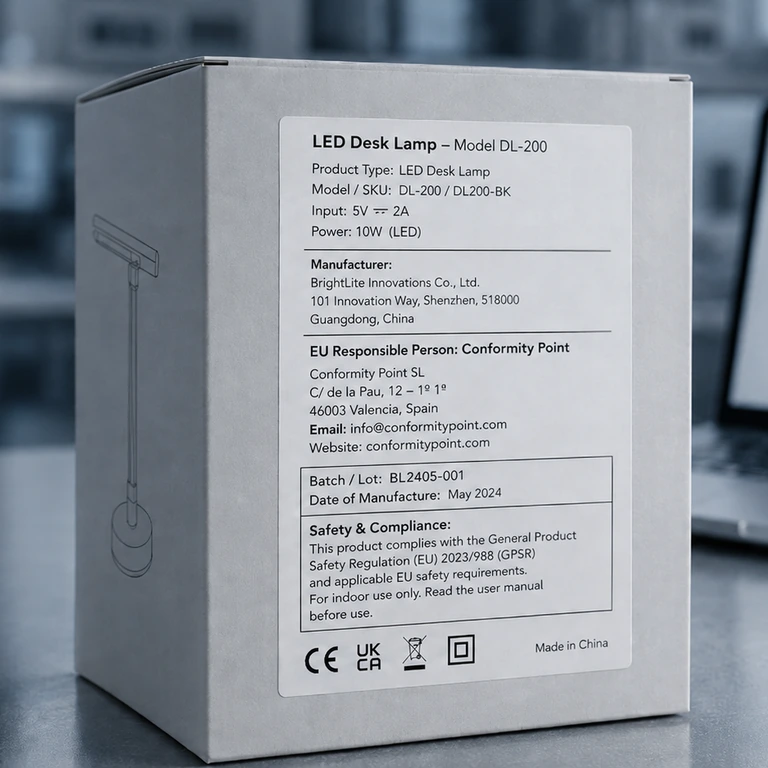
Quick answer
Regulation (EU) 2023/988 — known as the GPSR — requires that any consumer product placed on the EU market includes specific information in a visible and legible manner: a product identifier, manufacturer details, and — when the manufacturer is not established in the EU — the details of a responsible person. Safety warnings and instructions depend on the product, its risks and the country of sale. For online sales, that same information must appear on the product listing before the consumer completes the purchase.
What are GPSR labelling requirements
The GPSR does not define a single label format. It establishes what information must be available to the consumer before and after purchasing the product. The objective is traceability and safety: identifying the product, locating the responsible operator, and providing guidance on safe use.
The information can be distributed across the physical product, the packaging or outer box, and an accompanying document (instructions, manual, safety sheet). For distance selling — marketplaces, e-commerce, digital catalogues — part of that information must also appear on the online listing before purchase.
Not all requirements apply to all products in the same way. The product type, its risks, the economic operator and the countries of sale determine what is mandatory in each case.
What information must appear on the physical product
According to Regulation (EU) 2023/988, the product must include:
Product identification
An identifier that allows the product to be traced: model number, batch number, serial number, reference or equivalent. It must be visible to the consumer where the characteristics of the product allow.
Manufacturer details
The manufacturer’s name, registered trade name or registered trademark, postal address and electronic contact address. These details remain required when the manufacturer is outside the EU; the EU Responsible Person’s details are added where applicable and do not replace them.
Importer details (where applicable)
Where there is an importer, they must indicate their name, trade name or trademark, postal address and electronic address on the product or, where that is not possible, on the packaging or an accompanying document. Their details do not replace the manufacturer’s.
Safety warnings and instructions
These depend on the product, its intended use and its risks. They must be written in a language easily understandable by consumers in the Member State where the product is marketed, as determined by that State. Not all products require the same warnings: this requires a product-specific assessment.
When packaging or an accompanying document can be used
The permitted location depends on the information. Product identification belongs on the product; if its size or nature does not allow this, it may appear on the packaging or an accompanying document. Manufacturer and importer details follow that rule where placing them on the product is not possible. The EU Responsible Person’s details may appear on the product, packaging, parcel or an accompanying document under Article 16(3).
Do not move all information to the packaging simply for convenience. Check the rule for each item of information and include the instructions and warnings needed for safe use.
What must be included in the online listing or marketplace
When a product is sold through distance selling channels — marketplace, online store, digital catalogue — certain information must be displayed on the listing before the consumer completes the purchase. Under the GPSR, the online listing must include:
- Manufacturer details: name, brand or trade name, postal address and electronic address.
- Responsible person details when the manufacturer is not established in the EU.
- Information identifying the product: product image, type, model or other identifier.
- Applicable warnings or safety information that the consumer needs to know before purchasing the product.
This directly affects those selling on Amazon, eBay, Bol.com, Cdiscount or any other European marketplace. The online listing is not just a marketing matter: it is part of regulatory compliance.
Not sure whether your online listing or product label comply with the GPSR? A prior review avoids urgent corrections and account suspensions before you publish.
Check our EU Responsible Person serviceWhen the GPSR applies and when it does not
The GPSR applies to consumer products — new, used, repaired or reconditioned — placed on the EU market from 13 December 2024 onwards, that are not covered by specific EU sectoral legislation providing an equivalent level of safety requirements.
It does not apply to:
- Medicinal products, medical devices, food, feed and other products regulated by specific EU sectoral legislation that already establishes equivalent safety requirements.
- Antiques.
If a product is subject to sectoral legislation that already imposes specific labelling requirements (such as toys, electrical equipment or personal protective equipment), that legislation takes precedence in what it regulates. The GPSR acts as the general safety framework for what is not covered.
Risks of an incomplete label or online listing
Selling a product with incorrect or incomplete GPSR labelling can result in:
1.Product detention or withdrawal by market surveillance authorities.
2.Listing removal on marketplaces (Amazon, eBay, etc.) for non-compliance with product policies.
3.Liability of the importer or responsible person in relation to product safety incidents.
4.Consumer complaints if instructions or warnings are insufficient.
5.Urgent correction costs: reprinting labels, modifying packaging, updating listings and reshipping stock can multiply the initial cost of a preventive review.
Practical checklist before selling
Before publishing or importing the product into the EU, verify:
Common GPSR labelling mistakes
1.Confusing CE marking with GPSR compliance
CE marking is only mandatory for products subject to sectoral legislation that requires it (specific directives and regulations). The GPSR does not impose CE marking on all consumer products.
2.Relying solely on a QR code
A QR code can be a useful complement to provide additional information (manuals, videos, extended instructions), but it does not automatically replace the physical labelling obligations under Article 9 of the GPSR. Information that must be available on the product or packaging remains mandatory.
3.Omitting the responsible person from the online listing
When the manufacturer is not established in the EU, the responsible person's details must also appear in the online offer — not only on the physical label.
4.Not adapting the language by country
Publishing the same listing in English for the whole of Europe, or only translating warnings into one language, is a common mistake that causes problems on marketplaces.
5.Treating an internal SKU as a sufficient identifier
The identifier must allow the product to be traced externally, not only within the manufacturer's internal systems.
FAQ on GPSR labelling requirements
What to remember before selling in Europe
GPSR labelling is not simply a question of what text to put on the box. It is a distributed information system spanning the product, packaging, documentation and online listing — and it must work as a coherent whole. An error at any of those points can block the sale, trigger market withdrawals or create legal liability.
Reviewing labelling is faster and less costly before manufacturing or importing than after. At Conformity Point we review your label, packaging, safety documentation and online listing to identify GPSR gaps before you publish or import your product into the EU.
Official sources

Author
Written by Juan Manuel Beltrán, Founder & Product Compliance Consultant at Conformity Point. Specialist in consumer product compliance for the European market, he helps manufacturers, importers and brands sell consumer products in Europe.
Published: 7 May 2026