
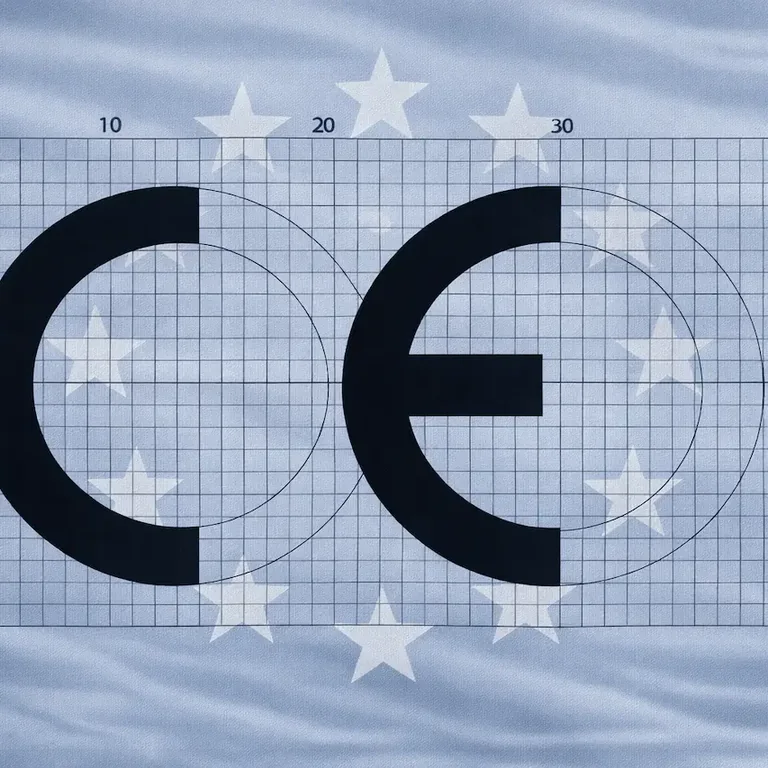
CE marking is a formal declaration by the manufacturer that a product complies with the applicable European legislation on safety, health, and, where relevant, environmental protection. It is not a quality label, nor does it indicate that the product was manufactured in the European Union.
It is important to understand this from the outset: CE marking does not apply to all products. It is only mandatory for those categories specifically regulated by a European directive or regulation. A wireless charger, an electric toy, or an air fryer need CE marking. A t-shirt, a bag, or a wooden chair, in general, do not. The difference lies in whether a European regulation exists that covers that type of product.
If you sell or import products in Europe such as household appliances, electronics, toys, lighting, or electrical equipment, CE marking is part of the legal process for placing products on the market. It is the starting point of any product compliance process.
What CE marking is for
CE marking is the market access requirement for the European single market for products that fall within its scope. Without it, those products cannot be legally sold in any EU Member State or in EEA countries such as Norway, Iceland, or Liechtenstein. Its main function is to align technical and safety criteria across European countries, removing the need for separate assessments per market. Once a product has valid CE marking, it can circulate freely throughout the harmonised area. It is important not to confuse it with external certification or a quality endorsement. Responsibility for conformity lies with the manufacturer or whoever places the product on the market, not with a certifying body.
Which products need CE marking
CE marking is only mandatory for categories covered by specific European directives or regulations. Not all products sold in Europe require it.
Categories that do require CE marking
Some products that do not require CE marking
These products are not subject to CE marking, although they may be regulated by other European legislation such as the General Product Safety Regulation (GPSR), substance restrictions, or labelling requirements:
- Textiles, footwear and fashion
- Non-electrical furniture
- Cosmetics and personal care
- Food and food supplements
- Decorative items without electrical components
Not requiring CE marking does not mean being exempt from regulatory obligations in Europe.
New Approach Directives and Regulations that require CE marking
CE marking exists because European legislation requires it under each of the following regulatory frameworks:
| Directive / Regulation | Scope |
|---|---|
| Low Voltage Directive (2014/35/EU) | Electrical equipment between 50–1000V AC / 75–1500V DC |
| Electromagnetic Compatibility Directive (2014/30/EU) | Equipment that generates or is susceptible to electromagnetic disturbances |
| Radio Equipment Directive (2014/53/EU) | Equipment that emits or receives radio waves (WiFi, Bluetooth, Zigbee...) |
| Toy Safety Regulation (2009/48/EC) | Products designed or intended for play by children under 14 |
| Personal Protective Equipment Regulation (2016/425/EU) | PPE across all risk categories |
| Machinery Directive (2006/42/EC) / Regulation 2023/1230 | Machinery and equipment with moving parts |
| Gas Appliances Regulation (2016/426/EU) | Appliances burning gaseous fuels |
| Pressure Equipment Directive (2014/68/EU) | Vessels, piping, and accessories under pressure |
| Construction Products Regulation (305/2011/EU) | Materials and systems permanently incorporated into works |
| Medical Devices Regulation (2017/745/EU) | Medical devices across all classes |
| Recreational Craft Directive (2013/53/EU) | Recreational craft from 2.5 to 24 metres and personal watercraft |
| ATEX Directive (2014/34/EU) | Equipment for use in potentially explosive atmospheres |
| Measuring Instruments Directive (2014/32/EU) | Meters and regulated measuring equipment |
This table is not exhaustive. Some products may fall under more than one directive simultaneously.
Who is responsible for CE marking
Primary responsibility lies with the manufacturer. They must ensure the product passes the conformity assessment, keep the technical documentation up to date, and sign the EU Declaration of Conformity before placing the marking on the product. However, other economic operators also carry specific obligations:
Manufacturer
Responsible for the entire process: assessment, documentation, marking, and declaration of conformity. If operating outside the EU, they must appoint an Authorised Representative established in European territory.
Importer
The party placing a product manufactured outside the EU on the European market. They must verify that the manufacturer has correctly carried out the conformity assessment, that the product bears the CE marking, and that the required documentation is available.
Distributor
The party supplying the product through the distribution chain. They must exercise due diligence and verify that CE marking is present when mandatory. If they modify the product or sell it under their own brand, they may assume manufacturer obligations.
Authorised Representative
A natural or legal person established in the EU, mandated in writing by the manufacturer to act on their behalf before European authorities. This is a mandatory requirement for manufacturers established outside the EU who place products on the European market.
How to get CE marking step by step
The process varies depending on the product category and the applicable directive or regulation. Some products allow manufacturer self-certification; others require the involvement of a notified body. In general terms:
Identify the applicable European legislation based on category and intended use.
Assess the essential requirements that must be met.
Carry out the necessary technical tests, internally or through an accredited laboratory.
Compile the technical file with all documentation demonstrating conformity.
Determine whether a notified body is required and, if so, complete that process.
Draft and sign the EU Declaration of Conformity.
Affix CE marking to the product in a visible, legible, and indelible manner.
There is no single universal path: conformity assessment has different modules depending on the directive and the product's risk level.
What documentation is required
Technical file
Contains all technical information: description, design, drawings, components, risk analysis, solutions adopted, and test results. It must be kept available for market surveillance authorities for the period set by the applicable legislation, generally 10 years from the last date of manufacture.
EU Declaration of Conformity
A document signed by the manufacturer or their representative declaring that the product meets all applicable essential requirements. It must include, among other elements, the manufacturer's name, the product description, the applied directives or regulations, and the standards used.
Instruction manual
Mandatory under most directives. It must be written in the official language of the country of commercialisation.
Test results
Reports demonstrating compliance with the technical requirements. Legislation allows, in certain cases, for the manufacturer to carry out their own assessment without third-party involvement. However, in practice, many actors in the distribution chain — European customs, large retailers, and marketplaces such as Amazon — require reports from accredited or notified laboratories to accept the product for commercialisation. Having third-party accredited tests is not always legally mandatory, but it is common practice and often commercially necessary.
Where the CE symbol must be placed
- It must be visible, legible, and indelible.
- Minimum height of 5 mm, unless the applicable product legislation specifies otherwise.
- It must be placed on the product, its rating plate, packaging, or accompanying documentation, as required by the applicable directive.
- It must not be accompanied by any symbol that could be confused with it.
If the product is too small to include the marking directly, it may be placed on the packaging or in the accompanying documents, provided the applicable legislation explicitly permits this.
CE marking for imported products
Products manufactured outside the EU must meet exactly the same requirements as those manufactured locally. Geographic origin does not exempt a product from any obligation. The importer, upon placing the product on the European market, takes on the responsibility of verifying that the manufacturer has correctly carried out the conformity assessment and that CE marking is validly affixed.
Products sold under a private label
If a company purchases a product from an external manufacturer and markets it under its own brand, it may assume manufacturer obligations. This means taking responsibility for the entire conformity chain: technical file, declaration, and marking.
Substantially modified products
If an imported product is significantly modified before being placed on the market, it may be treated as a new product for regulatory purposes, which restarts the conformity assessment process.
Common mistakes and possible penalties
Most common mistakes
- Placing CE marking on a product not covered by any European directive or regulation.
- Marketing a product subject to CE legislation without having obtained it.
- Having CE marking but lacking a technical file or Declaration of Conformity.
- Copying another product's technical file without adapting it to the specific model.
- Failing to update documentation when the product or applicable legislation changes.
- Confusing CE marking with the "China Export" symbol (also CE), which has a similar design but no regulatory value in Europe.
Consequences
Improper use of CE marking can result in the product being immobilised or withdrawn from the market, administrative penalties, and, depending on the severity and country, criminal liability. Each Member State's market surveillance authorities have powers to act against non-compliant products.
The European Safety Gate system (formerly RAPEX) records notifications of dangerous or non-compliant products. Appearing in that register has direct and immediate commercial consequences.
How to know whether your product needs CE marking
The correct approach is to identify the product category, its intended use, and its technical characteristics, and cross-reference them against current European legislation. There is no single closed universal list: classification depends on multiple factors that vary by product. Some commonly referenced directives are the Low Voltage Directive, the Radio Equipment Directive, the Toy Safety Regulation, and the PPE Regulation. Applicability always depends on the specific product and its individual technical analysis.
If you are unsure whether your product needs CE marking or want to check whether your current documentation is sufficient, the most effective step is to carry out an initial assessment with a product compliance specialist.
Frequently asked questions
Does your product need CE marking?
At Conformity Point, we help manufacturers, importers, and brands manage the product compliance process from initial analysis to final documentation. If you don't know where to start or have questions about your current situation, get in touch.
View CE Marking ServiceWhat to keep in mind before selling in Europe
CE marking is not an optional formality for the products that require it. It is the legal gateway to the European market. Understanding what it means, who is responsible for managing it, and what documentation it involves enables more informed decisions and helps avoid problems at customs, in the distribution chain, or with market surveillance authorities. If you already know what you need, the next step is to verify whether your product falls within the scope of any European directive or regulation. If you don't yet have that clarity, that is exactly the starting point.

Author
Written by Juan Manuel Beltrán, Founder & Product Compliance Consultant at Conformity Point. Specialist in consumer product compliance for the European market, he helps manufacturers, importers, and brands sell consumer products in Europe.
Published: 10/03/2026