
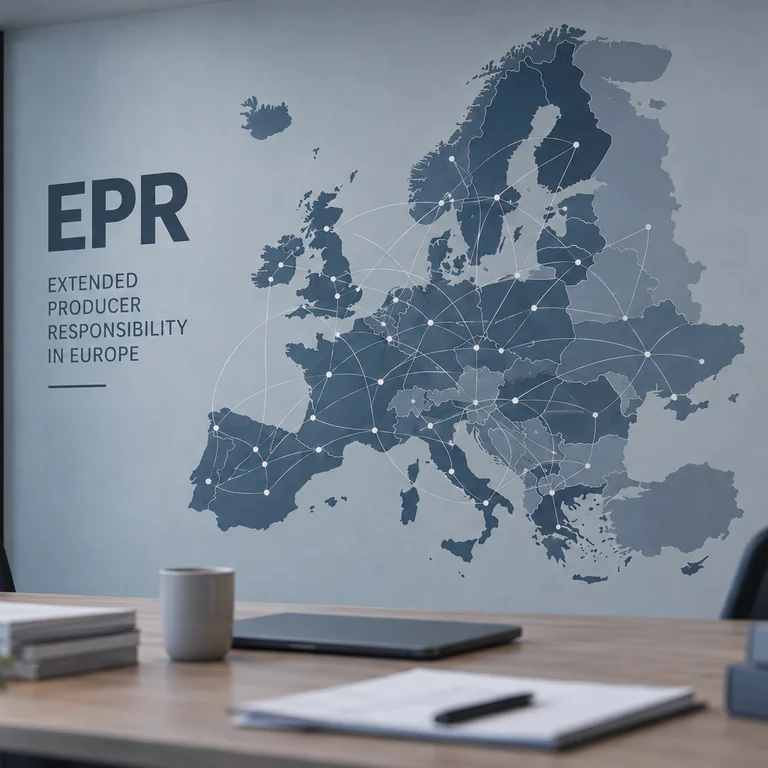
If you manufacture, import or sell consumer products in several EU countries, you will quickly come across EPR — Extended Producer Responsibility. EPR Europe is often presented as if it were one EU-wide registration. It is not. If you place products or packaging covered by EPR on the market of a Member State and you are legally considered the producer, you must comply with that country's obligations: typically registration, reporting and financing end-of-life management. EPR is not a product certificate, does not replace CE marking or the GPSR, and is not a single environmental tax. In Spanish, EPR is commonly referred to as Responsabilidad Ampliada del Productor (RAP).
This guide is for manufacturers and brands, EU importers, and non-EU sellers — including Amazon and other marketplace sellers — that need to understand how EPR actually works before expanding across Europe.
1What is EPR in Europe — and what is it not?
The EU extended producer responsibility framework is an environmental policy approach under which the producer bears financial responsibility and, depending on the scheme, organisational responsibility when products become waste. Its general legal basis is Directive 2008/98/EC and the “polluter pays” principle.
EPR regulations are not product certification or product-safety requirements; those sit under frameworks such as CE marking, the GPSR or other product-specific rules. EPR is also not one tax. It normally involves national registration and, depending on the country and category, participation in a PRO, periodic reporting and financial contributions. A new country or product category can therefore require a new assessment.
2Who needs EPR registration to sell in the EU?
EPR obligations can apply both to businesses established in the EU and to sellers based outside the EU. The key question is not where your company is based, but who is legally considered the producer for the relevant EPR category and national market.
Who is the “producer”: the manufacturer, importer or online seller?
“Producer” is a legal role, not necessarily the physical factory. Depending on the EPR category and sales model, it may be the manufacturer, EU importer, brand owner or, in distance selling, the non-EU seller itself. An Amazon seller outside the EU can therefore be the producer even if it does not physically manufacture the product and is not selling its own brand. The exact conclusion depends on the category, supply chain and Member State.
3Which EPR categories can apply to the same product?
One product can require several separate EPR registrations in the same country. Wireless headphones, for example, may create packaging, WEEE and battery obligations at the same time.
Packaging EPR (PPWR)
The Packaging and Packaging Waste Regulation — PPWR, Regulation (EU) 2025/40 — applies from 12 August 2026. Packaging obligations remain national in practice, and some countries also require specific disposal information on packaging. France uses Triman/Info-tri; Italy uses the etichettatura ambientale (environmental labelling) with material identification and disposal instructions; Spain requires the collection fraction or bin to be indicated for household packaging, commonly shown through the familiar yellow, blue, green, etc. bin pictograms. From 2028, the PPWR moves toward harmonised packaging labels, not a single EU EPR registration.
WEEE and batteries
WEEE under Directive 2012/19/EU and batteries under Regulation (EU) 2023/1542 have their own registration and reporting frameworks. Packaging, WEEE and batteries are the most common EPR categories for consumer products, but national schemes can go further. France, for example, also covers categories such as textiles, furniture, toys, sports and leisure articles, and DIY/garden products.
Emerging category: Directive (EU) 2025/1892 introduces EPR schemes for textiles, textile-related products and footwear. Member States must establish national schemes by 17 April 2028; there is not yet one fully harmonised EU-wide operating system.
4Is one EPR registration enough for the whole EU?
No. One EPR registration does not automatically cover every country or every category. Each country/category combination can involve a public producer register and, where applicable, a PRO (Producer Responsibility Organisation). In Spain, collective schemes are commonly called SCRAP (Sistema Colectivo de Responsabilidad Ampliada del Productor). Registration and PRO membership are not the same thing. Examples include Germany's LUCID register for packaging; France's SYDEREP/IDU system and eco-organismes; Spain's Registro de Productores de Producto and SCRAPs; and Italy's CONAI for packaging, with separate registers for WEEE and batteries.
For non-EU sellers specifically, there is also no single rule on local representation. For batteries sold by distance sellers, an EPR authorised representative is required in each relevant Member State. For packaging, the PPWR allows Member States to require representation, and countries such as Spain and Germany already do so. Other systems work differently. Germany is a useful example: a foreign producer must complete the initial LUCID registration itself, while its authorised representative can take over the other EPR obligations. It is therefore not correct to say that a non-EU seller can never register directly; it depends on the country and category.
This is where multi-country EPR compliance providers become useful. Instead of dealing separately with every register, PRO and local representative, you send one provider your company information and sales quantities by country, material and category. The provider then coordinates registrations, local representation, PRO memberships and periodic reporting, either directly or through local partners. You still receive separate EPR numbers for each country/category; what becomes centralised is the administration and data flow. Examples include ecosistant — pan-European e-commerce —, AVASK — marketplaces and e-commerce —, Interzero — multi-country compliance — and Landbell Group — global and corporate. Registration can take several weeks and, depending on the country or category, a few months. Reporting frequency also varies by country and category.
5What Amazon and marketplace sellers should prepare for EPR compliance
- List the countries where you will sell and confirm who is the producer in each one.
- Check each product for packaging, WEEE, batteries and any additional national categories.
- Complete the required registrations and appoint a PRO or representative where required.
- Prepare the data: weight of each packaging material and, for batteries, battery category and chemistry, plus quantities sold.
- File reports and payments and provide the relevant EPR registration numbers to the marketplace when requested.
For Amazon EPR, valid registration numbers may be required for relevant countries and categories. Amazon and other marketplaces can restrict or deactivate listings where required EPR information is missing. In some countries and categories, Amazon's EPR Pay on Behalf service reports and pays eco-contributions for Amazon sales and then charges those amounts plus a service fee. It does not necessarily replace obligations for sales made outside Amazon.
6Common EPR mistakes
- Assuming one registration covers the entire EU.
- Assuming the physical factory is always the producer.
- Treating registration as complete EPR compliance.
- Registering packaging but forgetting WEEE or batteries.
- Assuming the marketplace takes over the seller's legal obligations.
7Frequently asked questions about EPR Europe
Important: an EPR authorised representative is legally different from the Responsible Person required under the GPSR. They are different roles; one appointment does not automatically cover the other.
8What to remember before selling in Europe
Before entering a new market, check three variables for every product: SKU, EPR category and Member State. EPR in Europe is not one uniform administrative step; it must be mapped country by country and category by category.
EPR is only one part of consumer-product compliance in Europe, alongside CE marking, technical documentation and the GPSR within a wider EU regulatory compliance framework. At Conformity Point, we review your product, documentation and applicable compliance framework and help identify where separate EPR obligations need to be addressed. This service does not include managing EPR registrations, periodic reports or EPR payments.
Want to review your product compliance before expanding across Europe?

About the author
Written by Juan Manuel Beltrán, Founder & Product Compliance Consultant at Conformity Point. He specialises in consumer-product compliance for the European market and helps manufacturers, importers and brands sell consumer products in Europe.
Technical and regulatory review: Conformity Point. Last updated: 4 September 2026.
This article is a general guide and does not constitute legal advice. The application of the requirements described depends on the product category, function, design, intended use, risks, applicable legislation, EPR category, Member State and the documentation available for the specific product.