
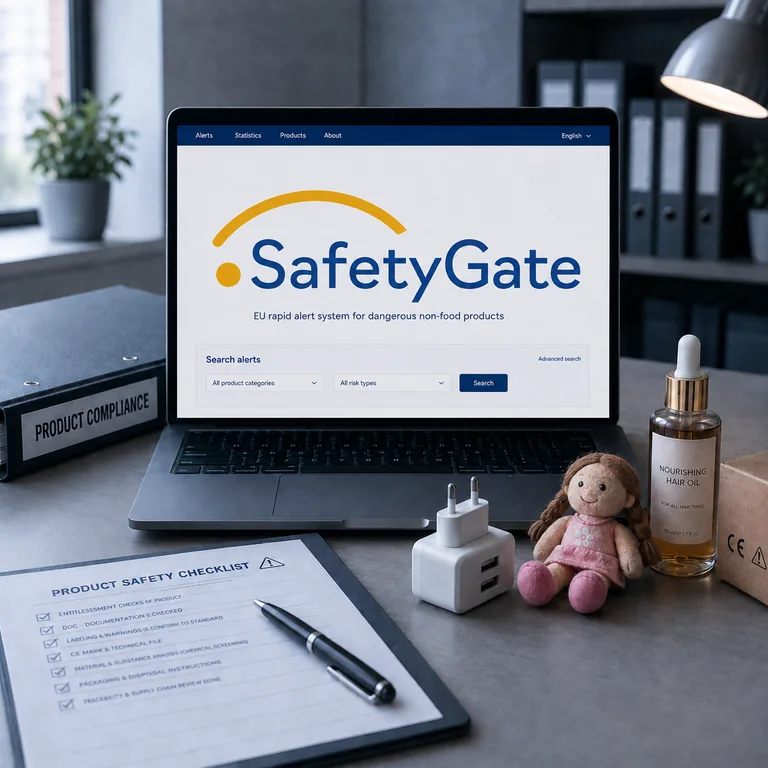
Safety Gate is the EU rapid alert system for dangerous non-food products, formerly known as RAPEX. Its purpose is to allow the European Commission and national authorities to share information quickly when a product presenting a risk is detected, and to coordinate the measures needed to restrict its marketing, withdraw it from the market or recall it from consumers.
This system was previously known as RAPEX. Although the name has changed, its function remains the same: to enable a coordinated response between authorities when a dangerous product is identified in one of the participating countries.
For a business, a dangerous product alert can have simultaneous effects in several markets. It may lead to documentation requests, a product withdrawal or a product recall, removal of online offers or sales bans. That is why it is important to understand not only what Safety Gate is, but also how an alert is generated and which aspects should be reviewed before placing a product on the market in the European Union.
It is worth distinguishing three elements that are often confused:
Safety Gate Rapid Alert System is the system used by the European Commission and national authorities to exchange notifications and follow-up actions.
Safety Gate Portal is the public part where consumers, businesses and distributors can consult the published alerts.
Safety Business Gateway is the tool through which economic operators and, where applicable, online marketplaces report dangerous products, accidents and corrective measures to the authorities.
Businesses do not publish an official Safety Gate alert directly. When they detect that a product may be dangerous, they must submit the relevant reports through Safety Business Gateway. National authorities then submit the official notifications in the rapid alert system.
1How Safety Gate works step by step
The process normally begins when a national authority detects a dangerous product or receives enough information to consider that a risk exists.
From that point onwards, the process can be summarised in five stages.
- 1
The product is identified and the risk is assessed
The authority analyses the product, the hazard detected and the severity of the risk. It may also request information from the manufacturer, the importer, the distributor, the responsible person or other operators involved in its marketing.
The assessment may draw on tests, inspections, complaints, accidents, technical documentation or information from other countries.
- 2
Corrective measures are adopted
Measures may be voluntary, where the company itself acts, or mandatory, where they are ordered by the competent authority.
Depending on the case, they may include suspension of sales, a ban on marketing, withdrawal of the product from the supply chain, recall of units already delivered to consumers or the publication of warnings.
Not all alerts produce exactly the same consequences. The measures depend on the product, the risk, the number of units affected, the countries where it has been sold and the actions the company has already taken.
- 3
The national authority submits the notification
The authority enters into the system the relevant information about the product, the risk identified and the measures adopted or planned.
Notifications concerning serious risks must be submitted in the cases established. Safety Gate may also be used to share measures relating to risks that do not reach that level of severity.
- 4
The European Commission reviews and distributes the alert
The Commission checks the information and makes it available to the authorities of the other participating countries.
The public alert usually includes data such as the product category, the brand, the model, photographs, the notifying country, the description of the risk and the measures adopted.
- 5
Other countries carry out follow-up actions
The authorities of the other States check whether the product is also present in their physical or digital markets.
When they find it, they may adopt additional measures and report those actions as follow-up to the initial alert. In this way, a problem detected in one country can trigger interventions in several European markets.
2Which products are covered by Safety Gate and which are excluded
Safety Gate is used for dangerous non-food products, both consumer products and products intended for professional use.
The categories that may appear in the system include:
- toys;
- cosmetics;
- clothing;
- electrical appliances and equipment;
- motor vehicles;
- childcare articles;
- protective equipment;
- tools;
- leisure and sports products.
The risks notified are also varied. They may be chemical, electrical, mechanical or thermal, as well as risks of fire, injuries, suffocation, strangulation or choking. In certain cases, alerts may relate to risks to the environment, security or other public interests.
Medicinal products, medical devices, food and feed fall outside the system, because they have their own sector-specific alert mechanisms.
This does not mean that all products included in Safety Gate are subject to the same obligations. The applicable framework depends on the product category, its intended use, the type of user, the design, the risks and the relevant sectoral legislation.
3What happens if a product appears in Safety Gate
The publication of an alert is not simply an entry in a database. It can have immediate operational consequences for the company responsible for the product.
Possible measures include:
- banning or suspending its marketing;
- withdrawing units from distributors, warehouses or points of sale;
- recalling products that are already in the hands of consumers;
- removing listings and offers on marketplaces;
- detaining goods or preventing their entry at the border;
- requesting the technical file, tests, risk assessments or traceability information;
- requiring communications to consumers or distributors.
There is also a reputational impact. Alerts are publicly accessible and can be consulted by consumers, platforms, distributors, professional customers and authorities in other countries.
Withdrawal and recall do not mean the same thing
Withdrawal aims to prevent a product from remaining available in the supply chain. It may affect stock in warehouses, distributors, shops or marketplaces.
Recall targets products that have already reached the end user and seeks to have them returned, repaired, replaced or safely disposed of, depending on the measure adopted.
A recall is usually more complex and costly because it requires identifying the consumers affected, communicating the risk and organising the return or corresponding solution.
4How to prevent and manage a dangerous product incident
Preventing a Safety Gate alert does not consist solely of having a technical file, test reports and labelling that appear to be in order. The technical documentation must correspond to the product actually manufactured and placed on the market and provide sufficient evidence that it meets the applicable safety requirements.
Among other aspects, test reports and, where appropriate, certificates or documentation relating to materials and components should support that the product does not contain dangerous or restricted substances above the permitted limits, that small parts do not become detached during foreseeable use, that button batteries or other hazardous elements are not accessible, and that the product provides the necessary stability and strength. Where applicable, they should also cover risks such as dangerous edges, entrapment, electric shock, overheating or fire.
In addition, any change to materials, components, suppliers, design or manufacturing processes must be reviewed to confirm that the documentation and tests remain representative of the final product. Traceability should make it possible to identify batches, suppliers, distributors and destination markets, while complaints, returns or accidents should be analysed to detect potential problems before they lead to market surveillance action.
What to do when a possible risk is detected
If a company suspects that a product may be dangerous, it must act quickly and in an orderly manner.
The basic steps are:
- 1
Stop or limit sales if necessary.
- 2
Identify which products are affected (batches, countries, distributors, etc.).
- 3
Analyse the risk with real data.
- 4
Decide what to do with the product (repair, replace, withdraw or inform).
- 5
Notify the authorities where applicable through Safety Business Gateway.
- 6
Inform distributors, platforms and customers.
- 7
Keep all the documentation of the process.
The most important thing is to act quickly, but also consistently. Incomplete or poorly coordinated information can make managing the problem much more difficult.
Where the GPSR applies, the product must have a responsible economic operator established in the EU; the responsible person and the authorised representative are not necessarily the same figure, as we explain in this article on the differences between the responsible person and the authorised representative.
If you want to reduce the risk of an incident resulting in a Safety Gate alert, check before placing the product on the market that the product, documentation and traceability are consistent. Learn how Conformity Point can help.
5What the 2025 Safety Gate figures show
The European Commission's 2025 Safety Gate report recorded 4,671 alerts and 5,794 follow-up actions. This is the highest number of alerts recorded up to that point.
4,671
alerts
5,794
follow-up actions
These figures do not automatically equate to 4,671 products withdrawn. An alert may affect different models, batches or units, and the follow-up actions reflect the measures adopted by other countries after receiving the initial notification.
By product category:
Product categories
- cosmetics accounted for 36% of alerts;
- toys, 16%;
- electrical appliances and equipment, 11%.
As regards the risks identified:
Risks identified
A single alert may include more than one type of risk, so these percentages do not form a closed distribution adding up to 100%.
- chemical risk appeared in 53% of alerts;
- injuries, in 14%;
- choking, in 9%.
The data show that Safety Gate is not limited to a specific category or to products subject to CE marking. They also reflect the system's capacity to generate subsequent actions in other countries once a product has been identified as dangerous.
6Frequently asked questions about Safety Gate and RAPEX
If you are not sure whether your product and its documentation would stand up to a market surveillance inspection or a possible notification in Safety Gate (formerly RAPEX), discuss your case with Conformity Point.
Discuss my case
About the author
Written by Juan Manuel Beltrán, Founder & Product Compliance Consultant at Conformity Point. A specialist in consumer product compliance for the European market, he helps manufacturers, importers and brands sell consumer products in Europe.
Technical and regulatory review: Conformity Point. Last updated: 6 August 2026.
This article is a general guide and does not constitute legal advice. The application of the GPSR, Safety Gate and market surveillance measures depends on the category, function, design, risks, applicable legislation and documentation of the specific product.