
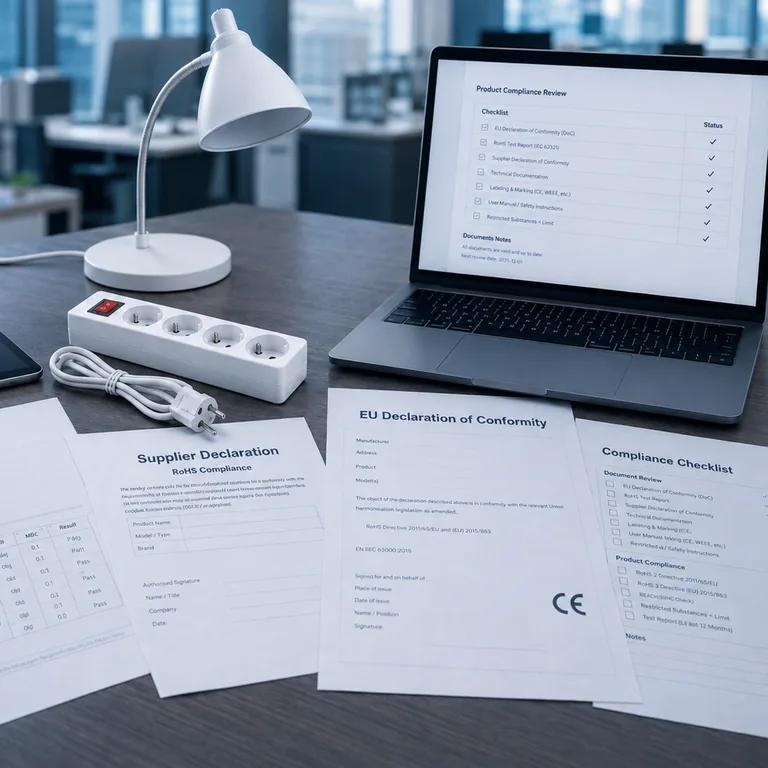
If you buy electrical or electronic equipment (EEE) already manufactured outside the European Union to place it on the EU market, the conformity assessment and technical documentation are the manufacturer's responsibility. Supporting evidence may come from laboratories, component manufacturers or suppliers, but the manufacturer must evaluate and compile it and ensure that it covers the product being placed on the market. Your responsibility doesn't end at keeping the certificate they send you: before placing the product on the EU market, you must check that the conformity assessment has been carried out, that sufficient technical documentation exists, and that the evidence exactly matches the model and configuration you're going to sell.
If you first want to understand what a RoHS certificate is and how the evidence is generated, start with our guide for manufacturers.
Key takeaways
- If you act as an importer, you must verify the conformity, the technical documentation drawn up by the manufacturer and the supporting evidence before placing the product on the EU market.
- Selling through a marketplace or presenting yourself commercially as a trader doesn't by itself determine your legal role: it depends on your actual position in the supply chain.
- If you market the product under your own name or brand, or modify it in a way that could affect its conformity, you will be considered the manufacturer and will take on those obligations.
1What you need to check if you act as an importer
Your legal role doesn't depend on your sales channel or on presenting yourself commercially as a trader or online seller. You are the importer when you're established in the European Union and you place on its market a product from a third country. If you buy the product from another operator who has already placed it on the EU market, you'll normally act as a distributor. A marketplace seller can take on any of these roles depending on their actual position in the supply chain.
If you act as an importer, the technical documentation must have been prepared by the manufacturer. Before placing the product on the market, check that the manufacturer has carried out the conformity assessment, has drawn up the technical documentation, has issued the EU Declaration of Conformity, and has affixed the CE marking where applicable. You must also verify that the product, the packaging or the documentation include the required identification details, and that the model matches the one covered by the RoHS evidence.
In addition, as the importer you must indicate your own name, registered trade name or registered trade mark and a contact address on the EEE or, where that is not possible, on its packaging or in an accompanying document.
The importer must keep a copy of the EU Declaration of Conformity for ten years from the placing of the EEE on the market, and ensure the technical documentation can be made available to the competent authority during that period. This doesn't mean you have to have prepared the manufacturer's file yourself, but you must make sure it exists and can be provided when requested.
If you consider or have reason to believe that the product does not comply with the RoHS Directive, you must not place it on the market until it has been brought into conformity. Where the product presents a risk, you must also inform the manufacturer and the competent market surveillance authorities. If non-compliance is identified after the product has been placed on the market, you must take the necessary corrective measures and, where appropriate, withdraw or recall it and inform the authorities.
If you market the product under your own name or brand, or modify it in a way that could affect its conformity, you will be considered the manufacturer for the purposes of the Directive and will take on the corresponding obligations: defining the evidence strategy, drawing up or compiling the technical documentation, and issuing the EU Declaration of Conformity.
2What to check in your supplier's RoHS report
Verify these 8 things before accepting the report your supplier gives you:
- Exact model and reference.
- Manufacturer and applicant identified.
- Photographs or a sufficient description of the samples analysed.
- Components and materials actually analysed.
- The ten substances, their limits and the applicable exemptions.
- Results, units, date and laboratory.
- Correspondence with the product's current configuration.
- Coverage of adapters, cables, accessories and variants you also sell.
Hypothetical case
A supplier hands over a report that only analyses the circuit board, but the product also includes a cable, an adapter and a housing from another supplier. The report is correct for what it analyses, but it doesn't demonstrate that the rest complies with the limits: additional evidence is needed to cover those components, whether reliable documentation from their suppliers or testing where necessary. A common example, not an actual Conformity Point case.
If you already have a report from your supplier, don't assume it's enough: check that it identifies the correct model and covers the actual materials. At Conformity Point we review that correspondence as part of our CE marking consulting service.
3What happens if the product doesn't comply with RoHS
The measures depend on the severity, the economic operator involved, and the legislation of the Member State handling the case. Authorities can request the technical documentation, the EU Declaration of Conformity, the test reports and any other evidence of compliance. If the documentation is insufficient, inconsistent or doesn't correspond to the product being made available on the market, they can require clarifications, additional documentation or new tests; if a significant non-compliance is confirmed, the measures range from adapting the product to withdrawing the affected units, recalling those already sold, prohibiting the product from being placed or made available on the market, or applying penalties under national legislation.
Products from outside the EU can also be checked when they enter the European market. Regulation (EU) 2019/1020 establishes this framework: the authorities designated by each Member State can suspend release for free circulation if they detect indications of non-compliance, missing documentation, or incorrect marking. This doesn't mean that all products are systematically inspected at the border, nor that a document called a "RoHS certificate" must always be presented: the scope of the check depends on the product, the information available and each authority's risk assessment.
In a joint European market surveillance action published by the European Commission on 18 June 2026, 173 items of electrical and electronic equipment were tested. Roughly half exceeded the limits in laboratory testing, with excessive concentrations found in solder and in the plastic materials of cables and plugs. Combining laboratory results with marking and documentation checks, 91 products (53%) were found non-compliant; the most common measures were withdrawing them before they reached consumers and banning their sale. These results correspond to the sample selected for that campaign and should not be interpreted as representative of the whole European market.
4Does a RoHS certificate from China or the United States work in Europe?
Not automatically. China has had its own regime for hazardous substances in EEE for years, with requirements that differ from the EU's, and has approved new mandatory requirements due to apply from 2027. The United States has no single federal regime equivalent to RoHS: there are state-level or sector-specific requirements, such as certain restrictions in California. A report or certificate prepared for China, the United States or another market doesn't automatically demonstrate compliance with Directive 2011/65/EU: review the substances analysed, the limits used, the samples, the scope and the reference legislation stated in the document.
This regime should not be confused with the misleading symbol commonly called China Export. See the differences between CE marking and China Export.
5Common mistakes when importing products with RoHS
1.Accepting a report without checking that the model matches the product being sold.
2.Confusing a commercial certificate with the EU Declaration of Conformity.
3.Treating an old report, or one issued for another market, as valid without reviewing it.
4.Assuming that testing the circuit board also covers cables, housing and accessories.
5.Not checking whether, by selling under your own brand, you've become the manufacturer.
6Frequently asked questions about RoHS for importers
7What to remember before selling in Europe
Keeping your supplier's report isn't enough: check that the RoHS evidence covers the model, the materials and the actual configuration of what you're selling, and that the manufacturer has met the requirements for technical documentation and the EU Declaration of Conformity.
Conformity Point reviews that correspondence as part of the CE marking process, before the product reaches the European market or is requested by an authority or a marketplace. If you also manufacture or commission the manufacturing of the product, see our guide on what a RoHS certificate is and how the evidence is generated. Learn about our services at conformitypoint.com or contact us to review your case.
RoHS documentation review for importers
We review your supplier's RoHS documentation as part of the CE marking process, check whether it matches the product you plan to sell and identify gaps before it is placed on the EU market.
Official sources
- Directive 2011/65/EU — consolidated text in force as of 1 July 2026 (EUR-Lex)
- Regulation (EU) 2019/1020 on market surveillance and compliance of products
- European Commission — Electronic products tested for hazardous substances, 18 June 2026 (JACOP campaign)
- California DTSC — comparative note on California RoHS

About the author
Written by Juan Manuel Beltrán, Founder & Product Compliance Consultant at Conformity Point. A specialist in consumer product compliance for the European market, he helps manufacturers, importers and brands sell consumer products in Europe.
Technical and regulatory review: Conformity Point. Last updated: 28 July 2026.
This article provides general information. The application of RoHS depends on the category, function, design, components, exemptions and documentation of the specific product.